
Digid Labs / Labs

MCPWP operating WordPress through agents

A Digid Labs proof entry showing how strategy docs, GitHub traces, Elementor sections, SEO metadata, and verification checks can become a governed WordPress publishing workflow.

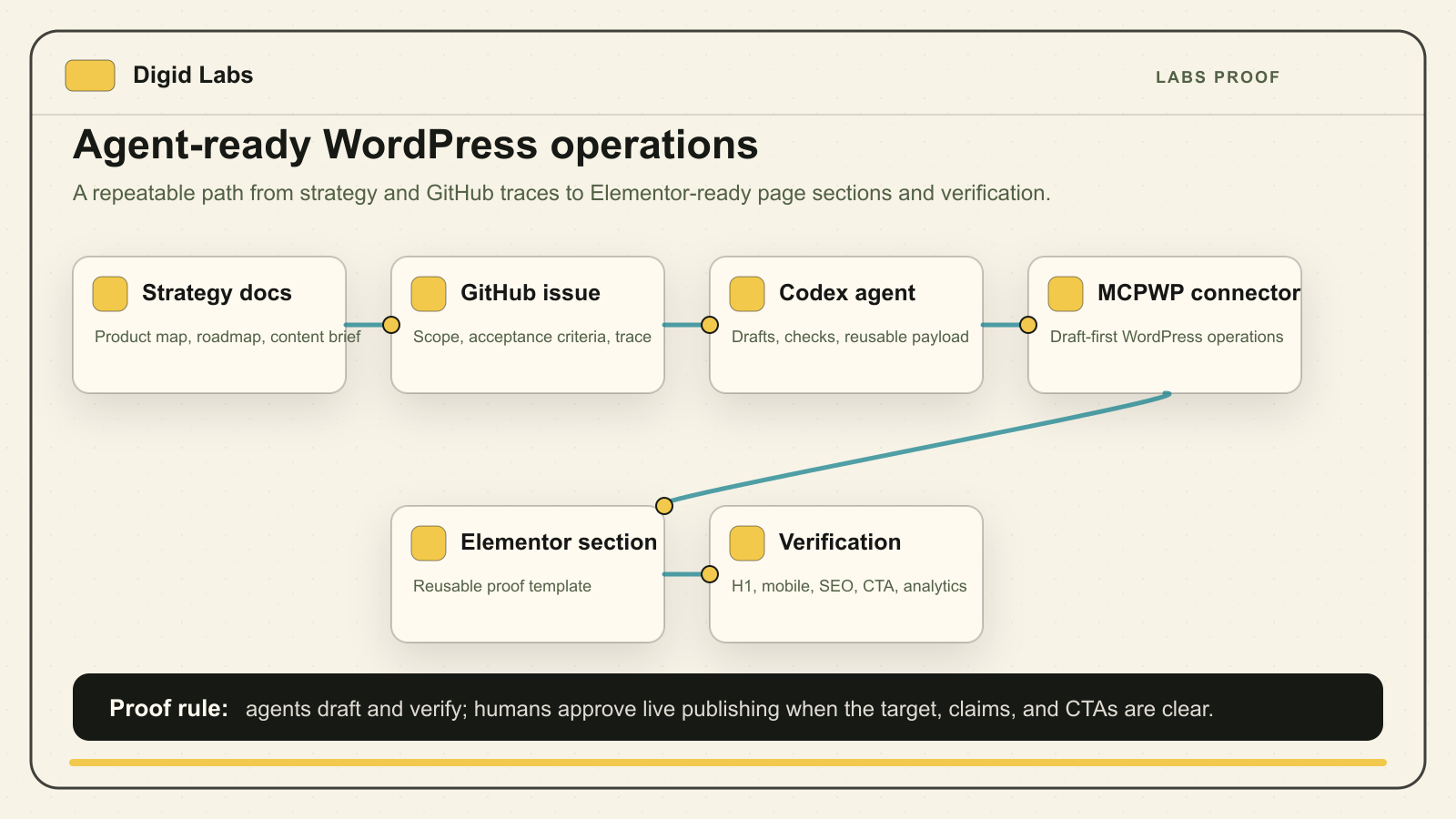
Diagram of the Digid Labs workflow for agent-ready WordPress operations.
The workflow connects Digid strategy, GitHub issue tracking, Codex drafting, MCPWP publishing, Elementor sections, and verification checks.

Problem

How do we make WordPress updates repeatable instead of one-off edits?

Digid has strategy docs, GitHub issues, live WordPress pages, Elementor templates, GHL funnel paths, and SEO requirements. Without a controlled pattern, each update risks becoming disconnected content with unclear CTA, weak measurement, and no durable trace.

What we tried

We turned the first Labs assignment into a draft-first Elementor page pattern: read the product map, choose the Labs basin, draft the proof entry, attach a reusable HTML section, upload a proof visual, and verify the page before publishing.

What worked

The pattern creates one reusable section for proof entries, keeps claims conservative, preserves GitHub and documentation traces, and routes the reader to the scorecard or review path.

What still needs controls

Live publishing still needs human approval for target slug, navigation, SEO rendering, CTA state, and any claim about partner status, pricing, certification, funding, or client examples.

Client meaning

Agent-ready publishing needs governance, not just generation.

  • Teams can approve templates and page sections before agents use them.
  • Draft-first workflows reduce the risk of uncontrolled live-site edits.
  • Verification checks can cover H1s, mobile overflow, metadata, CTAs, analytics tags, and CRM routing.

Need a governed AI-assisted publishing workflow?

If your WordPress site needs safer AI-assisted updates, start with the scorecard or book a review when you already have a workflow, backlog, or governance concern.

Scroll to Top